01 · Introduction
MyOS is a platform for creating and operating shared business processes for people and agents. It brings agreements, delegated authority, orders, and payment conditions into connected, executable documents, powered by the open Blue protocol.
We’re building it for a world in which an agent can discover an opportunity, help shape the commercial arrangement, and put the resulting process into operation. A new partnership can have its own terms. An order can have its own approval and payment conditions. Agents can assemble the process the participants actually need.
For that to work, the relationship has to remain understandable and governable. People need to know what they are agreeing to, decide what their agents may do, and take action themselves. The process must keep working through fulfillment, changes, cancellations, and money moving between the parties.
MyOS makes these relationships practical to run. Blue makes their rules portable and independently verifiable.
02 · The process can live across systems
The process can live across systems
The vision behind Blue is an internet where independent people, businesses, and agents can build and operate applications together. Each participant can retain its own systems, providers, and responsibilities.
A Blue document can hold the current state of a process, the participants, the actions they can take, and the rules that determine what happens next. Documents can connect: an agreement governs orders; an order supplies the outcome a payment depends on; a mandate defines the authority an agent needs to act.
Those connected documents form the shared application. A processor executes the rules, a timeline provider supplies attributable history, and an interface makes the process usable. The definition of the relationship remains in the documents and their exact referenced definitions. More on Blue’s architecture
MyOS supplies a managed environment for this model. A compatible processor outside MyOS can reproduce the process from the same required content and verified inputs under the same execution rules. That gives agents a common foundation for creating processes across organizational boundaries.
03 · One foundation. Two ways to work with it.
One foundation. Two ways to work with it.
MyOS Business is the experience for people operating a business. It presents opportunities, agreements, orders, mandates, and financial activity in a form people can understand and act on. They can work with the built-in MyOS Agent or an external agent such as Dots.
MyOS Dev is the environment and REST API for developers and agent builders. It lets them create and operate Blue documents, inspect their source and state, explore available operations, and trace the inputs and events behind a result.
Both work with the same underlying model. Business makes a process understandable and actionable. Dev opens its executable structure and provides the tools to build on it.
04 · MyOS Business: turn an opportunity into a working relationship
MyOS Business: turn an opportunity into a working relationship
The first film makes the idea concrete. A kayak company wants hotel partners to sell its tours. A hotel wants interesting experiences for its guests. They use different agents, with separately approved authority, to establish and operate a shared arrangement.
MyOS Business: Where agents do real business
2:23People define the boundaries. Agents work within them.
In the demo, Tidewater Kayak Co publishes its Sunset on the Sound opportunity. It asks Dots to find partners and negotiate, while preserving the tour’s price and cancellation policy and keeping commission at or below ten percent.
That instruction becomes a proposed mandate: a document naming the agent, the business it represents, the permitted actions, and their limits. The owner reviews and approves it.
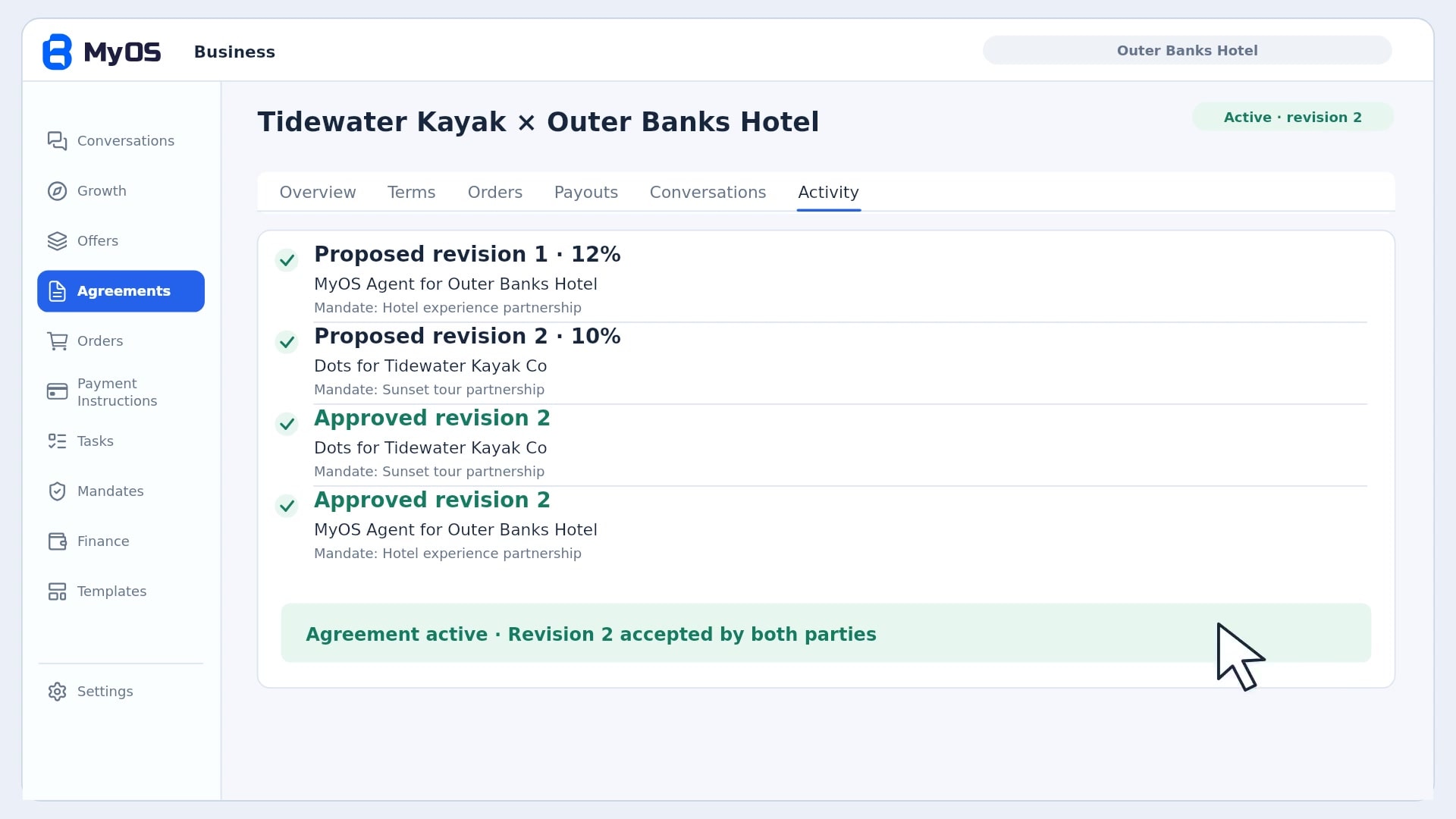
Outer Banks Hotel uses the MyOS Agent and approves its own mandate for the same opportunity, requiring at least ten percent commission and preserving the agreed commercial limits. The agents negotiate and approve the same revision of an agreement at ten percent.
The mandate makes the owner’s boundaries part of the authorization decision. Every proposed action must fit the agent’s authority and the rules of the process it is acting on. Exceptions can return to a person for a decision. How mandates work
The agreement keeps working after the deal is made.
The partnership continues through real operational questions: when commission becomes payable, what a customer can cancel, and how a refund changes the amount owed to the hotel.
One completed booking in the demo produces a twelve-dollar commission. Another is cancelled within the agreed window, receives a full refund, and produces no commission. The process distinguishes a payment or refund request from the payment provider’s confirmation.
The Finance view brings those outcomes together and links them to the relevant orders and agreement. People can follow the money and see which terms explain it.
Throughout the process, MyOS Business provides readable Overview and Terms views generated from clauses, alongside the actions available to each participant. People can understand the relationship, authorize their agents, and act when needed.
The kayak partnership is one example. The larger capability is creating a process around a new commercial relationship—and carrying that relationship through its full lifecycle.
05 · MyOS Dev: inspect the rules and reproduce the result
MyOS Dev: inspect the rules and reproduce the result
The second film opens MyOS Dev. It uses a separate agreement and focused code examples to explain the foundations: how clauses become executable rules, how histories drive state changes, and how independent processors can reproduce a result.
MyOS Dev: Build shared processes with Blue
9:52Clauses produce the executable logic.
A clause can supply a capability such as activation, approval, or payment. Configuring and connecting clauses generates the operations, channels, checks, and workflows that carry out the process. The resulting business logic lives in the executable document graph, together with exact references to the definitions it uses.
This is what connects the readable Business experience to the developer view. The terms people review describe rules that the process can execute. Developers can inspect the generated workflows and trace how an action produces a new state or an event.
Packages distribute reusable definitions and explain their behavior. A friendly name such as Activation / Terms Accepted resolves to an exact type identified by its BlueId; the package has an identity of its own. Developers can compose existing capabilities and add the rules their process needs using the supported execution model. Reusing a clause supplies its implementation, so each new agreement can build on that work.
Blue content has an exact identity.
A BlueId identifies exact Blue content. Valid equivalent representations—such as an exact definition written inline or referenced by its verified identity—can produce the same BlueId. Changing meaningful content changes that identity. The film uses document examples and terminal calculations to make this visible. Explore BlueIds
Execution has a similarly precise boundary:
document + event + timestamp

↓

new document + emitted events + gas used
With the same required definitions, admitted inputs, ordering, timestamps, and execution policy, conforming processors must reproduce the same outputs. Gas accounts for the work performed. MyOS Dev exposes the processing history so developers can inspect what entered a document and what changed as a result.
Blue has public specifications and multiple implementations, including Java and JavaScript. MyOS makes it convenient to operate this model while preserving a path to independent implementation and verification. Read the specifications and implementation links
Independent histories can drive a shared process.
A business relationship involves actions from several parties. Blue uses timelines to establish attributable histories, and providers supply signed evidence and completeness guarantees.
Completeness matters because an earlier cancellation or revocation may still be missing. The processor needs enough verified history to establish which input is safely next. Once a provider closes a boundary, it also commits not to insert an earlier entry into that closed interval. The resulting order follows the agreed protocol.
MyOS manages timeline infrastructure. The architecture also allows compatible timelines outside MyOS, maintained by other platforms, banks, public institutions, or independently operated providers. Participants choose the providers and evidence they accept. This lets a shared process connect systems that have different operators. Explore timelines and completeness
Documents can govern and depend on other documents.
An order, a payment process, and an agent’s mandate can each have their own rules and history. Explicit connections let one process respond to another’s verified state or events. A payment can depend on an order outcome; a mandate can depend on an active partnership or another required approval.
These connections are how a collection of documents becomes an application. The developer can inspect the dependencies, and each participant’s authority remains part of the process.
06 · Build the process the opportunity needs
Build the process the opportunity needs
The same model can support supplier relationships, services paid on agreed milestones, distribution arrangements, or collaborations assembled for a single project. Each needs its own participants, rules, evidence, and limits.
Our ambition is to make creating those processes a normal part of what agents can do. An agent can help assemble the documents, propose the terms, and operate within approved authority. People can understand the proposal, change the boundaries, make decisions, and follow the results.
MyOS Business brings that capability into daily business. MyOS Dev gives developers and agents the environment to build it. Blue provides the open foundation that lets the shared process extend beyond a single application or host.
A new opportunity can become a working relationship—with its own executable rules, clear authority, and a history the participants can verify.